Christina Nobel,
with the Gaddis of Himalaya
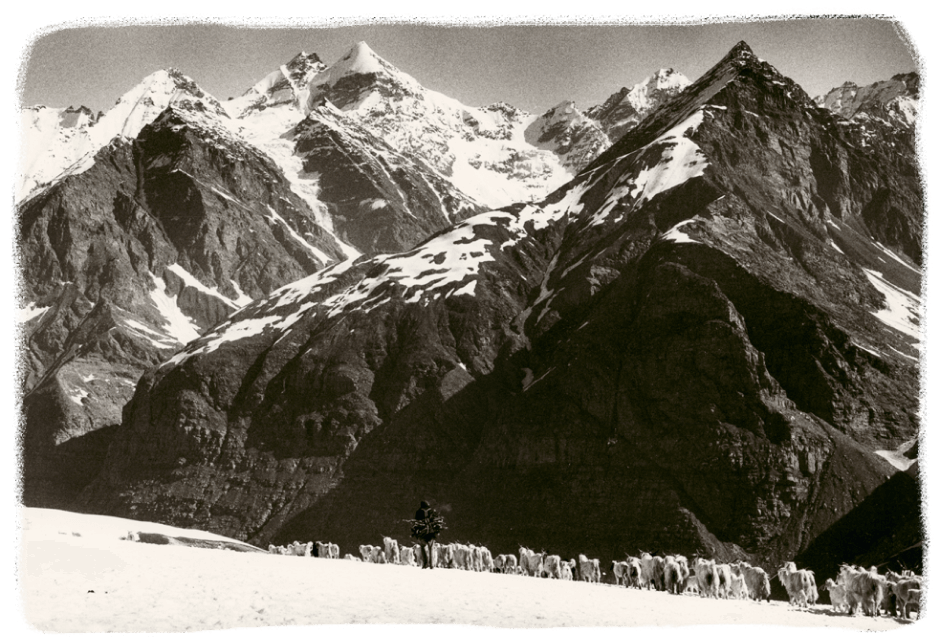
Flock of goats and sheep crossing the Rothang Pass 13,200 ft into Lahul from Kullu 1980
“I was driving from Scotland to Delhi in October 1967 when I first saw Gaddi shepherds. At the foot of the Dhaular Dhar a flock of milk white sheep and goats were resting in the shade. The shepherds were resting too, drawing slowly on their hookahs. They wore cloaks of white tweed kilted by a black rope wound round their waist. It seemed that biblical illustration had come to life. The scene remained one of the most vivid in my memories of the drive.”
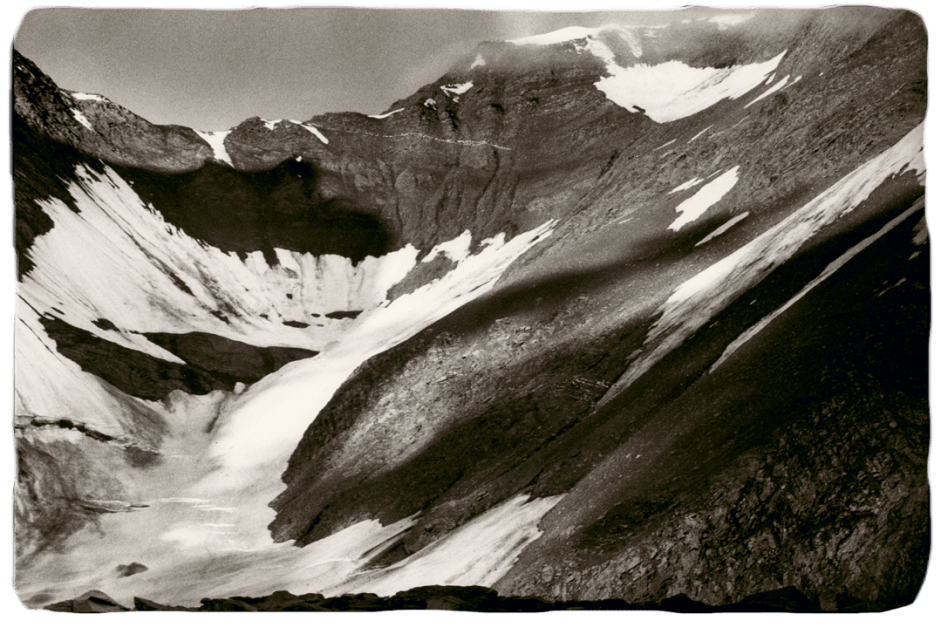
Kugti Pass, one flock on the pass 15,500 ft, another resting below. Crossing from Lahul to Bramour 1982
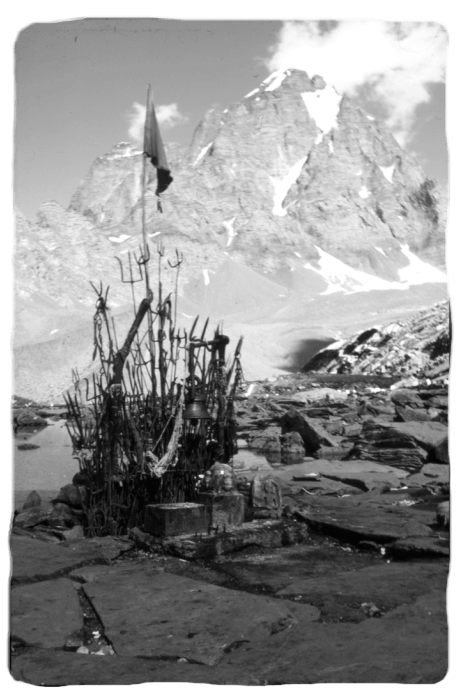
Shivji shrine at Manimahesh lake 1983
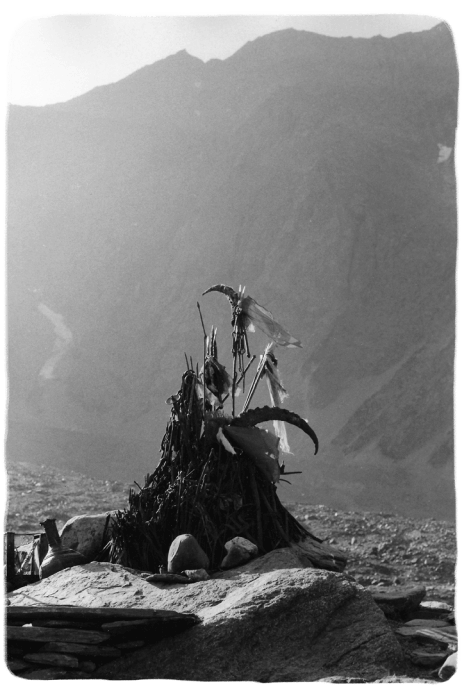
The shrine to Kuldeo in Jobrang nala, Lahul 1983
My next experience of Gaddis was on my first trek in the Himalayas. We had climbed up to the Kali Hind pass, 15,500 ft pass, west of Manali, Kullu and had spent some time sitting on its crest absorbing the eerie silence and the sense of eternity. Suddenly from the glacier below there was a feint bleating. There, caught in the opaque green ice, was a lamb. We pulled it out and cradling it slithered down the glacier and were struggling on the loose boulders of the moraine when we saw a shepherd coming up. Having crossed the pass much earlier he had reached his camp and then found the flock was a lamb short. He was astonished that anyone but a shepherd would have bothered to rescue the foundling. A day or two later we reached a village. He took me up into a house and insisted that his sister become my “dharm-behen”. She and I performed a ceremony; gave each other three nibbles of ghee, and three of gur, placed a tika mark on each other’s forehead, touched each other’s feet and then embraced, to the right and to the left twice. For years afterwards, though we seldom met, her village was a 10 day walk from Manali, we occasionally sent each other presents. She sent few jars of ghee and the medallions that Gaddinis wear, and I sent packets of tea or coloured head scarves.
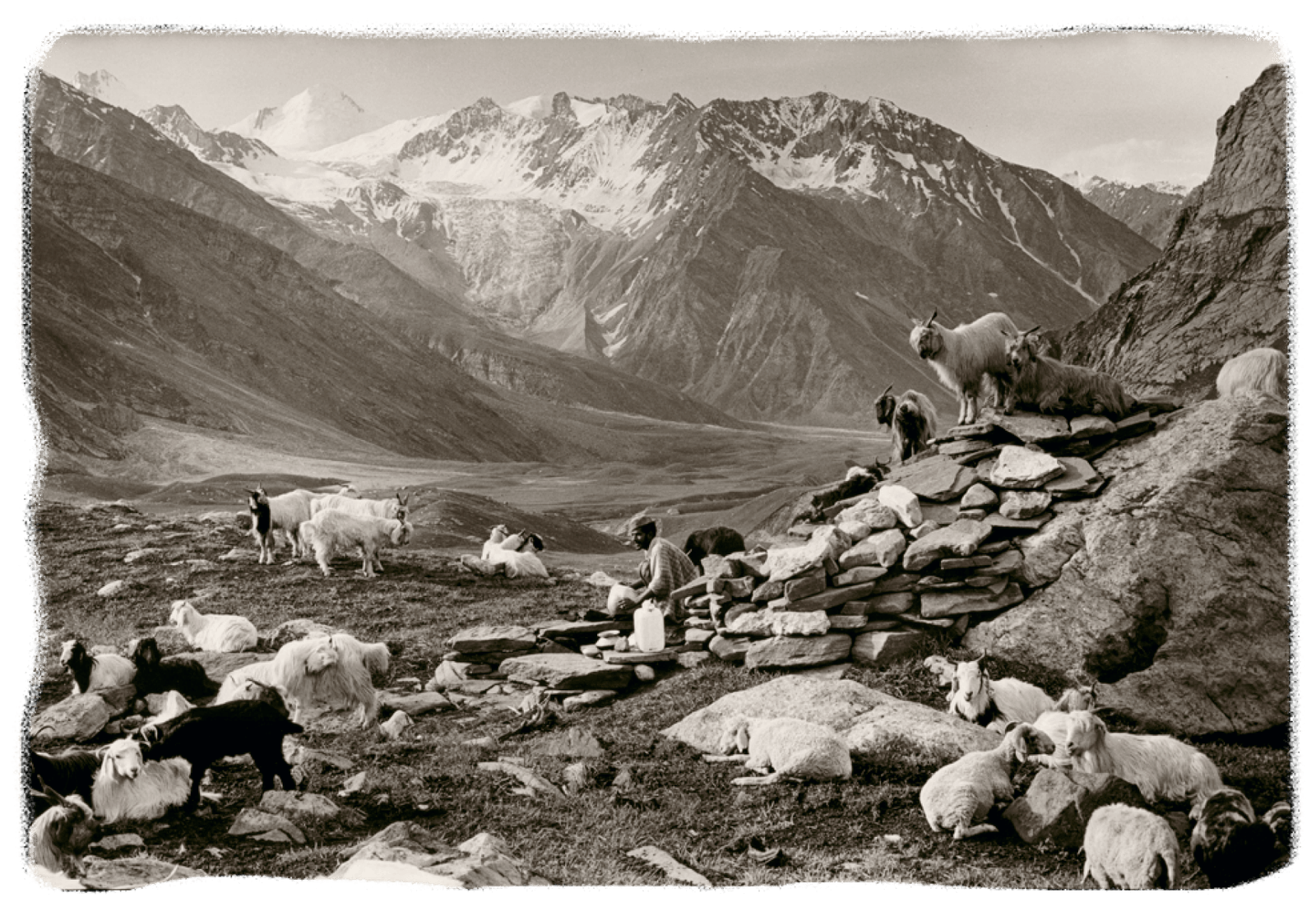
Gaddi churninglassi in a sheep skin sack Miyar Nala Lahul 1983
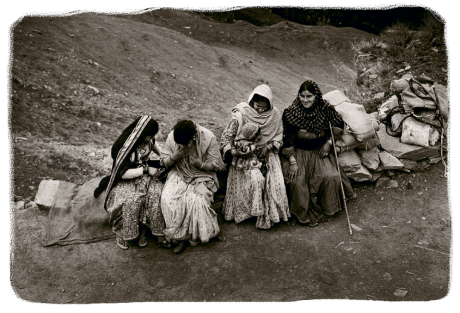
Four gaddini resting on the Ravi valley side of the Jalsu pass 1982
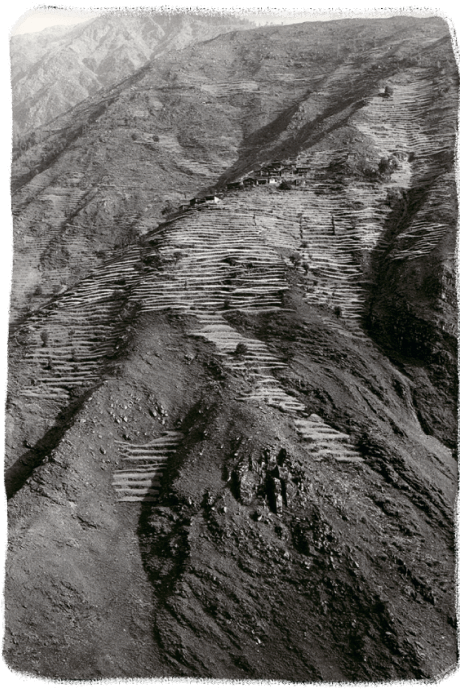
Terraced fields Ravi Valley Chamba 1982
So to learn more about the Gaddis and their lives I followed the pattern of their year. During their migration from the winter grazing to the summer, many- but not all of them- will pass through their home village in Gadderan on the way.
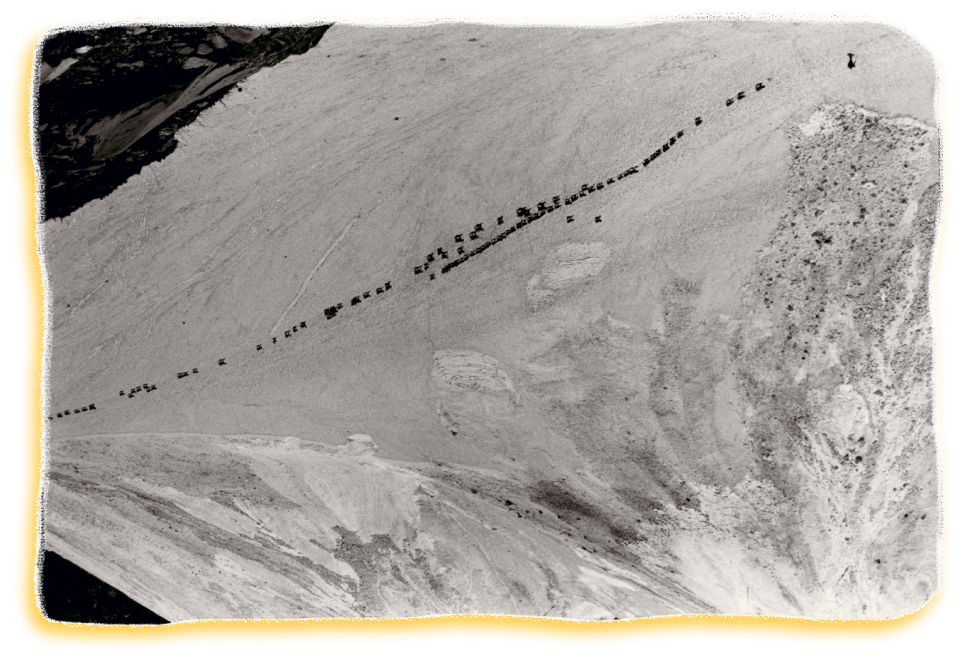
Gaddi and flock coming down from the Sach Pass from Chamba into Lahul 12,500 ft. 1980
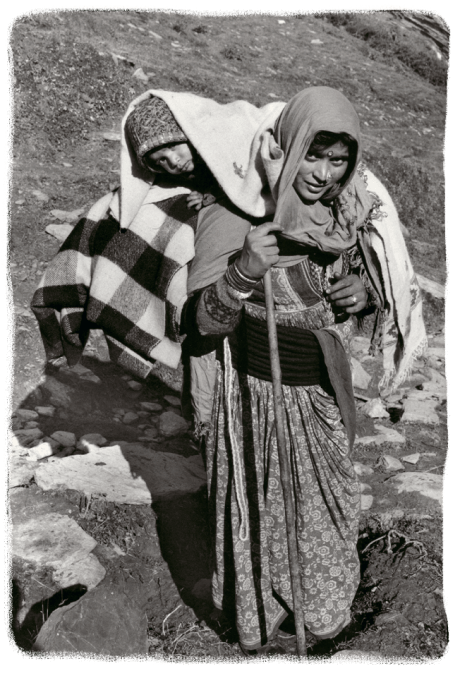
Gaddini carrying a child on the way up the Jaslu Pass
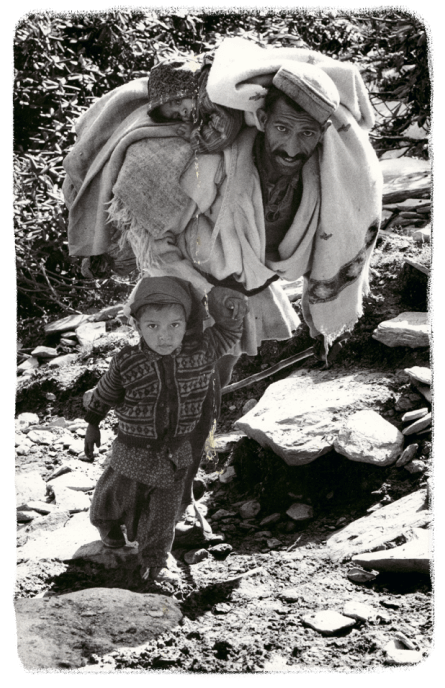
Gaddi carrying two children on the way up the Jalsu Pass
I saw them against the backdrop of the mountains. The landscape is without scale. The human eye cannot grasp it. Man’s efforts appear trifling, when you look carefully you are mesmerized by the intricate pattern of the terraces contouring down. These, the results of centuries of labour; the tiny strips grown the wheat, barley, rice, pulses and potatoes on which people must depend for their subsistence. At the head of a valley, you might spot a cluster of white dots; a flock barely discernible among the rocks and maggot- like in proportion to the landscape. By the end of my journey, I realized that those white dots were not insignificant: the flock was worth thousands of pounds!
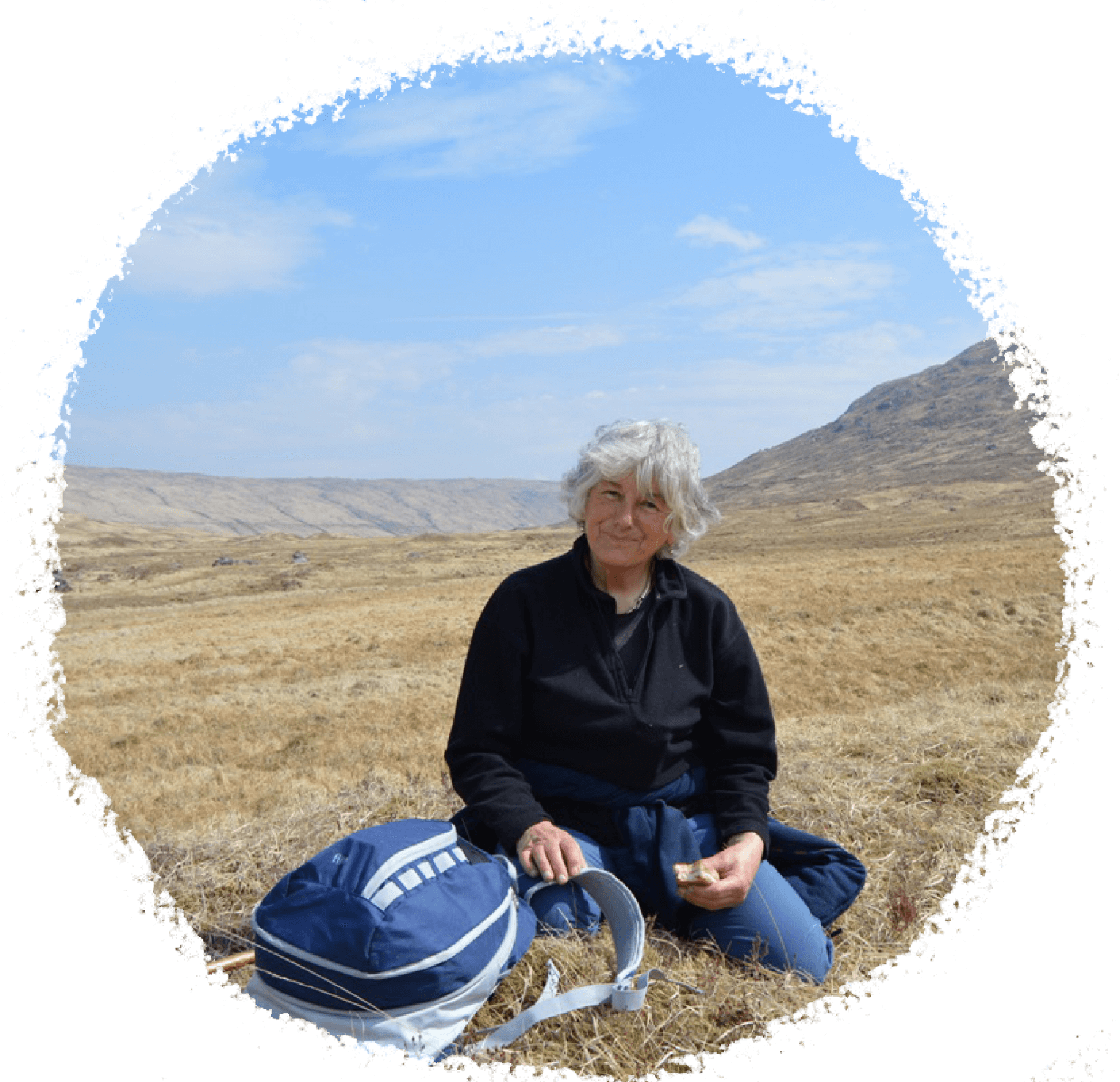
Christina Noble was born in 1942 in Argyll in the Scottish Highlands. She spent her childhood in Argyll and now she works there with a community development organisation called Here We Are.
She traveled and lived in India from 1965 to 1990. Her experiences of a life in Himachal Pradesh led to two books, Over the High Passes and At Home in the Himalayas. Over the High Passes is an account of a year spent living with the Gaddis, who are transhumant shepherds. At Home in the Himalayas talks of how both Ms Noble and Kullu, her place of residence, changed over twenty years.
Her photographic works, both in monochrome and colour, displayed in this exhibition has been shot over a span of nearly 45 years. She has been drawn to clarity of the light, scale of the mountains, and relationship they have with people and domestic buildings time and again and this has given her photographs a distinct identity.